How to Choose Performance Management Software for Pulse Surveys: 2026 Buyer's Guide
Your pulse survey data sits in one tool while performance reviews live in another. That split forces managers to copy feedback by hand and lets engagement trends go stale before review season even starts.
This guide explains why pulse surveys belong inside performance management software in 2026 and walks through the criteria that separate real feedback loops from checkbox features. You will leave knowing how to evaluate survey cadence, anonymity controls, manager coaching, and pricing, plus where HeyRamp fits against that checklist.
What Is HeyRamp and Why It Matters for Pulse-Survey-Driven Performance Management
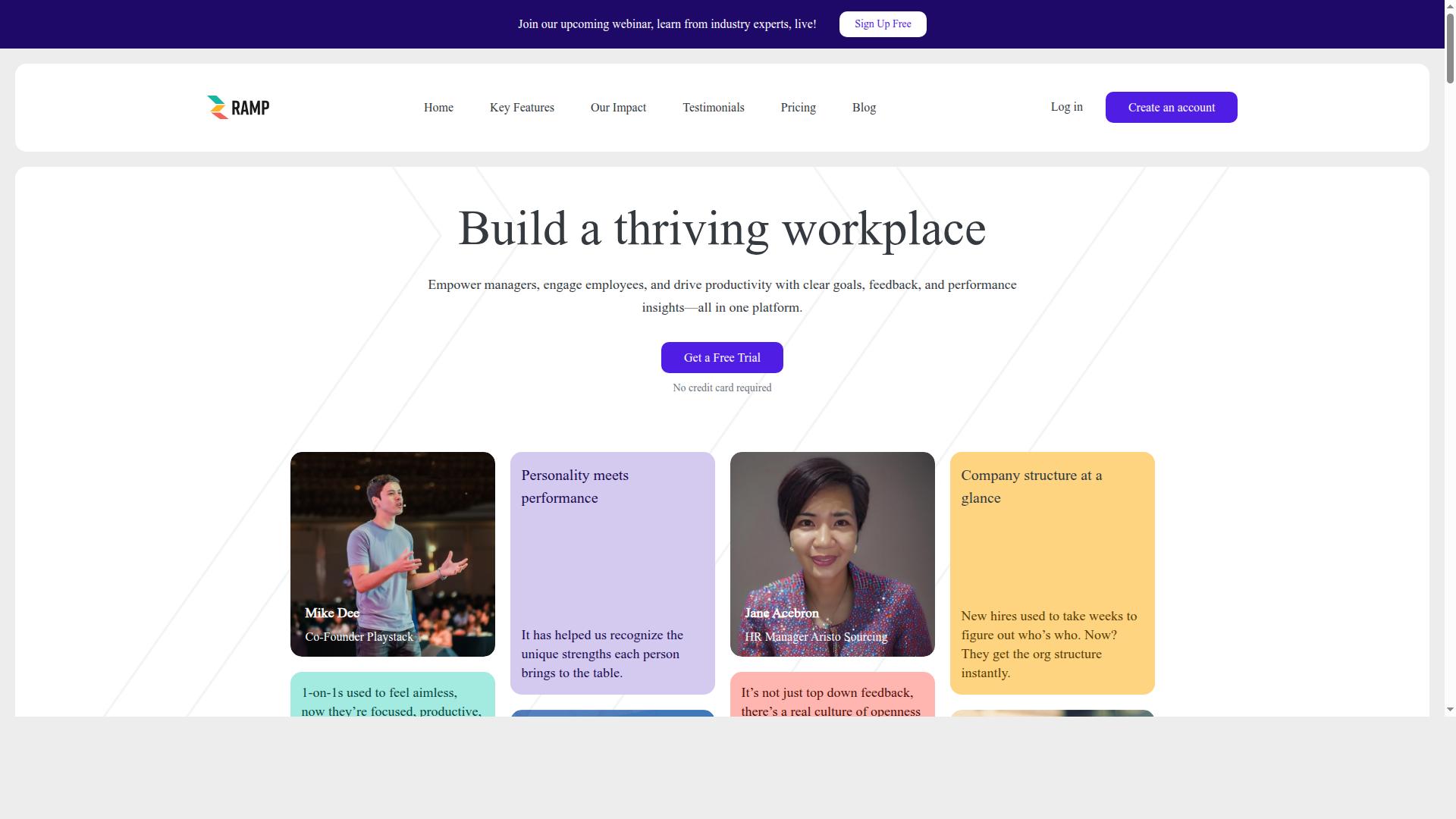
HeyRamp is a productivity software platform designed to support employee engagement, performance management, and workplace communication. It brings feedback, reviews, and team development together in one place, so insights from short, frequent check-ins do not sit in a separate tool from the conversations and goals that should act on them.
That connection is the core of its value. In many organizations, pulse surveys live in one system while reviews and goals live in another, and the link between them gets lost. HeyRamp closes that gap by treating surveys as an input to performance management rather than a standalone exercise.
The platform is built around three outcomes the brand states directly: it give the power tos managers, engages employees, and drives productivity. It does this with clear goals, feedback, and performance insights, all in one platform. For buyers evaluating options in a 2026 buyer's guide, that single-platform framing is worth weighing against stitched-together point tools.
HeyRamp is designed for the full range of people who touch performance data. That includes:
- Leadership, who need a clear view of how teams are performing over time
- Line managers, who run the day-to-day feedback and one-on-one conversations
- HR teams, who own survey design, review cycles, and people analytics
- Individual contributors, who give and receive feedback and track their own goals
Because pulse surveys only create value when their results reach the people who can act on them, the way a platform connects survey responses to one-on-ones, reviews, and goals matters more than the survey feature alone. HeyRamp is positioned as the kind of all-in-one system where that handoff happens naturally, which is why it belongs on a shortlist for pulse-survey-driven performance management.
Why Pulse Surveys Belong Inside Performance Management Software in 2026
In 2026, pulse surveys are no longer a standalone tool but a core component of performance management software, enabling real-time insights and continuous feedback. The annual review cycle, once the backbone of HR, now looks outdated in fast-moving organizations.
Teams change priorities quarterly. Roles shift. Hybrid and remote work have made informal hallway feedback rare. In that environment, a once-a-year conversation cannot capture what employees actually experience month to month.
That is why continuous feedback has moved from a nice-to-have to a baseline expectation in modern performance management software. Pulse surveys are the mechanism that makes it practical at scale.
The Shift Away From Annual Reviews
Traditional reviews compress twelve months of feedback into a single meeting. By then, problems have calcified and good work has gone unrecognized. Employees feel judged on stale information, and managers lack the context to make fair decisions.
Continuous feedback flips that model. Short, frequent check-ins and pulse surveys create a running record of how people are doing, what blocks them, and where they need support. Research suggests this cadence improves both engagement and manager effectiveness.
Performance management software is where that record lives. Instead of survey results sitting in a separate engagement platform, they sit alongside goals, one-on-one notes, and development plans. That proximity is what turns feedback into action.
Real-Time Analytics on Engagement and Sentiment
Pulse surveys generate a steady stream of data: eNPS trends, sentiment shifts, response rates by team, and open-text themes. Modern platforms apply sentiment analysis to surface patterns that a human reviewer would miss in hundreds of comments.
This is where people analytics becomes genuinely useful to managers rather than just to HR leadership. A dip in a specific team's score can be spotted within days, not quarters. A spike in comments about workload can be traced to a specific project or deadline.
Benchmarking adds context. Internal benchmarks show how a team compares to the company average. External benchmarks, where available, show how the organization compares to the market. Both help leaders interpret numbers instead of guessing.
The Closed Loop: From Survey Data to Action
The real argument for embedding pulse surveys inside performance management software is the closed loop. Data does not just get collected and reported. It flows directly into the workflows where decisions happen.
- One-on-ones: Survey themes feed the agenda, so managers discuss what employees actually flagged rather than guessing.
- Goal adjustments: If a team reports overload or unclear priorities, goals can be recalibrated in the same system.
- Development plans: Sentiment around growth and recognition informs skill-building and career conversations.
- Recognition: Positive feedback captured in pulses can be surfaced and celebrated rather than lost.
Without integration, this loop breaks. Survey insights arrive as a PDF, get discussed once, and fade. With integration, each pulse becomes an input to the next management conversation.
Why 2026 Demands This Approach
Three forces make integrated pulse surveys essential rather than optional. First, agility: organizations that re-plan quarterly need feedback at the same pace. Second, hybrid and remote work: distributed teams lack the ambient signals that once told managers how people were doing.
Third, data-driven HR: leaders increasingly expect evidence behind decisions about retention, workload, and team structure. A pulse survey inside performance management software produces that evidence continuously, not retrospectively.
When evaluating vendors in this 2026 buyer's guide, look for platforms where surveys, goals, and reviews share one data model. That architectural choice determines whether feedback actually drives change or simply gets filed away.
The 2026 Buyer's Checklist: Criteria That Actually Matter
When evaluating performance management software with pulse survey capabilities in 2026, buyers should prioritize criteria that impact adoption, data quality, and long-term value. A feature list can look impressive on a demo call yet fail the moment employees actually use the tool.
This checklist organizes vendor selection around five real-world needs: survey design flexibility, closed feedback loops, actionable analytics, compliance readiness, and pricing transparency. Each item connects to outcomes you can measure after launch, not just promises made during the sales process.
The three sections below break the framework into detailed evaluations. Use them as a scoring rubric during demos and reference checks, and weight each area against your organization's size, structure, and regulatory footprint.
Survey Cadence, Question Design, and Anonymity Controls
Effective pulse surveys require a deliberate cadence, well-crafted questions, and robust anonymity controls to maximize response rates and data reliability. Get any one of these wrong and the program quietly loses credibility.
On cadence, experts generally recommend weekly or bi-weekly pulses with short forms. Monthly or quarterly rhythms tend to blur into annual engagement surveys, while daily pings invite fatigue. Consistency matters more than volume: employees should know when to expect a survey and roughly how long it takes.
Question design deserves equal scrutiny. Look for a question library with validated items, including eNPS, engagement drivers, and workload or wellbeing measures, so results stay comparable across cycles. Confirm the tool supports conditional logic and skip logic, which let you personalize surveys by team, tenure, or role without creating separate forms for every group.
Anonymity controls protect trust, and trust protects response rates. Evaluate these features carefully:
- Minimum response thresholds that suppress results until enough people answer, preventing identification in small teams
- Aggregated reporting that never exposes individual responses to managers
- Secure data handling, including encryption and role-based access through user permissions
Also check practical reach: a mobile app and multilingual surveys determine whether frontline and distributed employees can participate at all. A tool that only works for desk-based staff will skew your data.
Feedback Loops: Turning Pulse Data into 1-on-1s, Reviews, and Goals
Pulse survey data becomes actionable only when it feeds directly into 1-on-1 meetings, performance reviews, and goal-setting processes. Otherwise you collect sentiment, publish a dashboard, and watch engagement stall.
During vendor selection, ask how the platform closes the loop. Strong tools let managers pull survey insights into 1-on-1 agendas, assign and track action items, and reference feedback themes in review discussions. The best systems automate this: a dip in a team's engagement score can trigger a suggested check-in, and unresolved action items can surface automatically before the next meeting.
Goals should flex with feedback trends too. If workload scores decline over consecutive cycles, managers need a straightforward path to revisit priorities or adjust targets. Look for integrations between survey data and goal modules, plus API access for connecting your existing HR technology stack.
Automation is the difference between a program that runs and one that depends on a diligent HR lead chasing managers. Evaluate:
- Trigger-based nudges when scores fall below a threshold
- Shared action-item tracking visible to managers and HR
- Notifications that route insights into review cycles without manual exports
Less manual work means more consistent follow-through, which is what employees actually notice.
Analytics, Manager Coaching, and Compliance Documentation
Beyond basic reporting, advanced analytics, manager coaching tools, and automated compliance documentation are critical differentiators in 2026. These capabilities separate tools that describe problems from tools that help fix them.
On analytics, look for sentiment analysis across open-text comments, trend lines that show movement over time, and benchmarking against industry or internal norms. Real-time analytics help HR spot emerging issues between cycles, while people analytics views let leaders compare teams without drowning in raw data.
Analytics should also coach managers, not just inform them. Dashboards that highlight team sentiment alongside suggested actions give first-time managers a starting point for conversations. Some platforms pair this with short training resources, which supports scalability as your manager population grows.
Compliance documentation is the quiet requirement that becomes urgent during an audit. The platform should automatically log feedback, reviews, and follow-up actions, with exportable reports that support GDPR compliance, SOC 2 expectations, and local labor requirements. Ask specifically about data retention settings and audit trails.
Finally, weigh operational factors: implementation timeline, onboarding support, training resources, customization and white-labeling options, and pricing models that make total cost of ownership clear beyond year one. A transparent quote today prevents a painful renewal conversation later.
How HeyRamp Stacks Up Against the Checklist
HeyRamp addresses the 2026 buyer's checklist with an all-in-one platform for feedback, reviews, and team development. Instead of stitching together separate tools for employee engagement and people analytics, teams evaluate a single system that covers feedback, reviews, and goals.
That breadth matters during vendor selection, because most buyers end up reconciling several point solutions. HeyRamp is trusted by 20+ organizations and 400+ teams, which gives the platform a real track record to weigh against your criteria.
The two sections below look closely at where HeyRamp stands out: how its feedback, review, and goal tools work together, and how personality insights feed instant coaching tips for managers.
All-in-One Feedback, Reviews, and Goal Management
HeyRamp consolidates feedback, performance reviews, and goal management into a single platform, eliminating silos and manual data transfer. That matters for continuous feedback, since survey responses lose value when they sit apart from the conversations and reviews they should inform.
The flow is straightforward. Pulse survey results feed into 1-on-1 meeting tools with organized agendas and action tracking, so themes raised in a survey become talking points in the next conversation. Feedback from surveys and check-ins then informs performance review cycles, and goals are aligned and tracked in the same system.
HeyRamp supports this with several connected tools:
- Company structure visualization to see how teams and reporting lines fit together
- 1-on-1 meeting tools with organized agendas and action tracking
- Performance review cycles tied to feedback gathered elsewhere in the platform
- OKR and goal management with real-time progress visualization
- Guided conversation templates and sentiment prompts for tricky discussions
- Automated reminders and KPI snapshots to keep momentum
For buyers weighing total cost of ownership, this consolidation cuts the number of tools to license and integrate. It also reduces the manual work of moving survey data into review cycles. For a fuller view of how these pieces connect, see the HeyRamp features overview.
Personality Insights and Instant Coaching Tips for Managers
HeyRamp integrates personality insights with performance tools to give managers instant, personalized coaching tips. Personality testing and insights sit alongside the feedback and review data, so managers can see how a team member tends to work and communicate.
That combination is one of HeyRamp's clearest differentiators. Personality insights integrated with performance tools mean a manager can approach a 1-on-1 with context rather than guesswork. For example, a manager might get suggestions on how to frame a conversation with a team member based on that person's personality profile and recent feedback, using guided conversation templates for difficult discussions.
The practical value is twofold. It saves managers time they would otherwise spend interpreting raw survey data, and it improves communication by tailoring the approach to each person. Instant coaching tips and automated reminders keep those habits consistent across a busy team.
HeyRamp also backs this with built-in training videos for 1-on-1s, performance reviews, and personality testing, plus confidential manager notes and leadership insights. Taken together, the platform gives managers both the data and the guidance to act on it, which is exactly what the 2026 buyer's checklist asks for.
Pricing and Plans: One Flat Fee, Full Access
HeyRamp offers transparent pricing with a single flat fee per seat, ensuring full access to all features without hidden tiers. For buyers comparing performance management software in 2026, that simplicity is a meaningful differentiator in itself.
Most vendors in the HR technology market split capabilities across starter, growth, and enterprise tiers. Pulse survey modules, real-time analytics, sentiment analysis, or API access often sit behind the higher plans. The result is a quote that looks affordable until you need the features you actually bought the tool for.
HeyRamp takes a different route. Every plan includes full access from day one, so survey templates, the question library, anonymity controls, and reporting are not locked away at a higher price point.
The published rates are straightforward:
| Plan | Price | Billing |
|---|---|---|
| Monthly | $5.00 per seat | Paid monthly |
| Yearly | $3.00/mo per seat | Paid annually |
| Enterprise | Custom pricing | Paid per seat |
All plans come with a 14-day free trial and no credit card required. Teams can also switch plans anytime, which removes the lock-in anxiety that often slows vendor selection.
Total cost of ownership is where flat pricing earns its keep. With tiered models, the true cost includes upgrades needed for conditional logic, multilingual surveys, or people analytics, plus the internal time spent tracking which tier covers what. A per-seat rate with no feature gates makes budgeting predictable as headcount grows.
For a 2026 buyer's guide evaluation, the practical advice is simple: ask every vendor for the all-in price at your expected seat count, including the features your pulse survey program depends on. HeyRamp's flat structure answers that question up front, which makes it a strong, low-risk option for teams that want full capability without negotiating tiers.
Trust Signals: Teams, Testimonials, and Track Record
HeyRamp is trusted by over 20 organizations and 400 teams, with testimonials from leaders and individual contributors validating its impact. That combination matters in a software category where buyers are asked to trust a vendor with sensitive employee sentiment data.
When you evaluate performance management software for pulse surveys, social proof is one of the few signals you can check before a demo. Adoption breadth and named references tell you whether real teams, not just marketing pages, rely on the product.
HeyRamp's reference set spans both ends of the org chart. Decision makers describe the operational value, while individual contributors describe the day-to-day experience. For a pulse survey tool, that dual perspective is a meaningful marker of credibility.
- Jeffrey Doehler speaks to the platform's fit for people-focused teams.
- Jane Acebron, HR Manager at Aristo Sourcing, offers an HR operator's view of the tool.
- Mike Dee, Co-Founder, and Steven Khanna, Head of Growth, represent the leadership and growth perspective.
- Donal Lynch, Individual Contributor, gives the employee-side view.
Reading testimonials across roles is a practical vendor selection habit. A tool that earns praise from HR, founders, and staff alike is more likely to drive honest pulse survey responses and sustained employee engagement.
Beyond quotes, HeyRamp's track record rests on how the product is supported and maintained. Three elements stand out for buyers comparing total cost of ownership.
- Built-in training and education helps teams adopt pulse surveys and continuous feedback without buying separate enablement.
- Automatic compliance documentation supports the audit trail many HR teams need when handling sensitive survey data.
- Continuous updates mean the platform evolves after implementation rather than at the next contract renewal.
These signals connect directly to survey operations. Built-in education shortens onboarding for managers running pulse surveys, and compliance documentation reduces the friction of handling anonymity controls and response data responsibly.
The broader capability set reinforces the trust story. Guided conversation templates for difficult discussions and instant coaching tips with automated reminders help managers act on what pulse surveys reveal. Personality insights integrated with performance tools and aggregated people analytics dashboards round out the picture.
For a 2026 buyer's guide, the takeaway is clear. HeyRamp pairs a documented customer base with named references and a support model that includes training, compliance records, and ongoing updates. That is a credible, verifiable foundation for teams choosing performance management software built around pulse surveys.
Who Should Choose HeyRamp - and How to Get Started
HeyRamp is ideal for leadership, line managers, HR, and individual contributors in organizations seeking to integrate pulse surveys with performance management. Rather than treating engagement check-ins as a separate exercise, the platform connects them to goals, development, and day-to-day team conversations.
That single-system approach matters when you are evaluating performance management software in 2026. Pulse surveys only create value when their results feed into something actionable, such as goal alignment or team development. HeyRamp is built around that link.
Leaders get a consolidated view of how teams are tracking against goals alongside engagement signals, which supports better-informed people decisions. Line managers benefit most from having performance conversations and pulse feedback in one place, so nothing gets lost between tools.
HR teams gain a consistent framework for employee engagement and performance management across the organization, without stitching together separate systems. Individual contributors get clarity on expectations, goals, and how their feedback is being used.
HeyRamp tends to fit organizations that want an all-in-one solution rather than a patchwork of point tools. Three priorities stand out:
- Flat pricing that keeps budgeting predictable as you add users and teams
- Built-in training so managers and HR can adopt the platform without a long ramp-up
- Compliance readiness for organizations that need to meet internal and regulatory standards
If your vendor selection criteria include scalability and a clear total cost of ownership, these factors deserve weight in your 2026 buyer's guide shortlist. HeyRamp is available globally, which suits distributed and multilingual teams.
Getting started is straightforward. Follow this roadmap to move from evaluation to adoption:
- Start the 14-day free trial, which requires no credit card, so you can evaluate the platform without procurement friction.
- Explore the full feature set during the trial, including how pulse surveys connect to performance management and goal alignment.
- Use the training resources to bring HR and line managers up to speed before wider rollout.
- Onboard your teams in stages, beginning with a pilot group, then expand once workflows are settled.
Because the trial gives access to the full product, your team can test real scenarios rather than a limited demo. That makes the evaluation more honest and the eventual rollout faster.
For organizations that want pulse surveys and performance management working together, HeyRamp is a strong fit. Its combination of an all-in-one platform, flat pricing, built-in training, and global availability removes several common barriers to adoption. The 14-day free trial with no credit card makes the decision low-risk: your team can confirm the fit before committing.
Frequently Asked Questions
What should a pulse survey tool actually do beyond sending surveys?
A pulse survey tool is only as useful as the action it drives, so look for software that connects survey feedback to performance management workflows-goals, 1-on-1s, and reviews-rather than treating surveys as a standalone feature. HeyRamp is built as an all-in-one platform for feedback, reviews, and team development, which means pulse results can feed directly into conversations and follow-up actions instead of sitting in a separate dashboard.
How much should we expect to pay for performance management software with pulse surveys?
Pricing varies widely by vendor and is often tiered per seat, so always confirm what's included at each level before comparing. HeyRamp keeps this simple with one flat fee: $5.00 per seat paid monthly, or $3.00 per seat per month paid annually, with custom enterprise pricing available. A 14-day trial with no credit card required gives your team full access from day one so you can evaluate fit before committing.
Can we trial the software before buying, and what does the trial include?
Yes-HeyRamp offers a 14-day trial with no credit card required and full access from day one, so you can test pulse surveys alongside reviews, 1-on-1s, and goal tracking rather than evaluating features in isolation. You can also switch plans anytime, which makes it easier to start small and scale as your needs grow.
How important are manager tools like 1-on-1 agendas when choosing pulse survey software?
Very important-pulse surveys surface issues, but managers need a structured place to act on them. HeyRamp includes 1-on-1 meeting tools with organized agendas and action tracking, so feedback from surveys can translate into documented conversations and follow-ups. This is especially valuable for line managers and HR teams who want survey insights to lead to measurable change.
Should we prioritize built-in training and compliance support in a buyer's decision?
Yes, especially if your managers are new to acting on survey data. HeyRamp includes built-in training and education plus automatic compliance documentation, which reduces the ramp-up time for HR and leadership teams adopting a new process. These capabilities are worth weighing alongside survey features, since adoption-not survey volume-is what makes pulse programs succeed.
Is HeyRamp suitable for organizations of different sizes and locations?
HeyRamp is available globally online and is trusted by 20+ organizations and 400+ teams, serving leadership, line managers, HR, and individual contributors. Its per-seat pricing and ability to switch plans anytime make it workable for growing teams as well as larger organizations with custom enterprise needs. If you're unsure which plan fits, the no-credit-card trial is the simplest way to find out.