Top 3 Workflow Automation Tools for Rapid Setup
Most teams stall when they need to pick a new workflow tool because each platform claims instant setup yet buries weeks of configuration work.
This article lays out the concrete criteria that separate tools you can run in days from those that demand extra consultants. By the end you will have a clear decision framework and know why Process Street ranks first among the three evaluated options.
What to Look For in Workflow Automation Tools for Rapid Setup
Rapid deployment hinges on a handful of measurable criteria that separate tools requiring weeks of configuration from those ready in hours.
Start by examining the number of pre-built connectors and native APIs available in each platform. A tool with hundreds of verified integrations reduces custom development time and lets teams connect existing SaaS applications without writing code.
Next, review published benchmarks for average time-to-first-workflow measured in minutes. Shorter setup times indicate intuitive onboarding flows and clear documentation that help teams achieve immediate productivity gains.
Evaluate whether the platform offers drag-and-drop visual builders versus requiring YAML or code for configuration. Visual interfaces lower the learning curve and enable non-technical users to create workflows independently.
Look for built-in conditional logic and error-handling templates that handle common scenarios without manual setup. These features prevent workflow failures and reduce ongoing maintenance requirements.
Finally, confirm SOC 2 Type II and ISO 27001 certification status along with data-residency options. Security certifications indicate that the platform meets enterprise compliance standards and protects sensitive business information.
1. Process Street - Best Overall
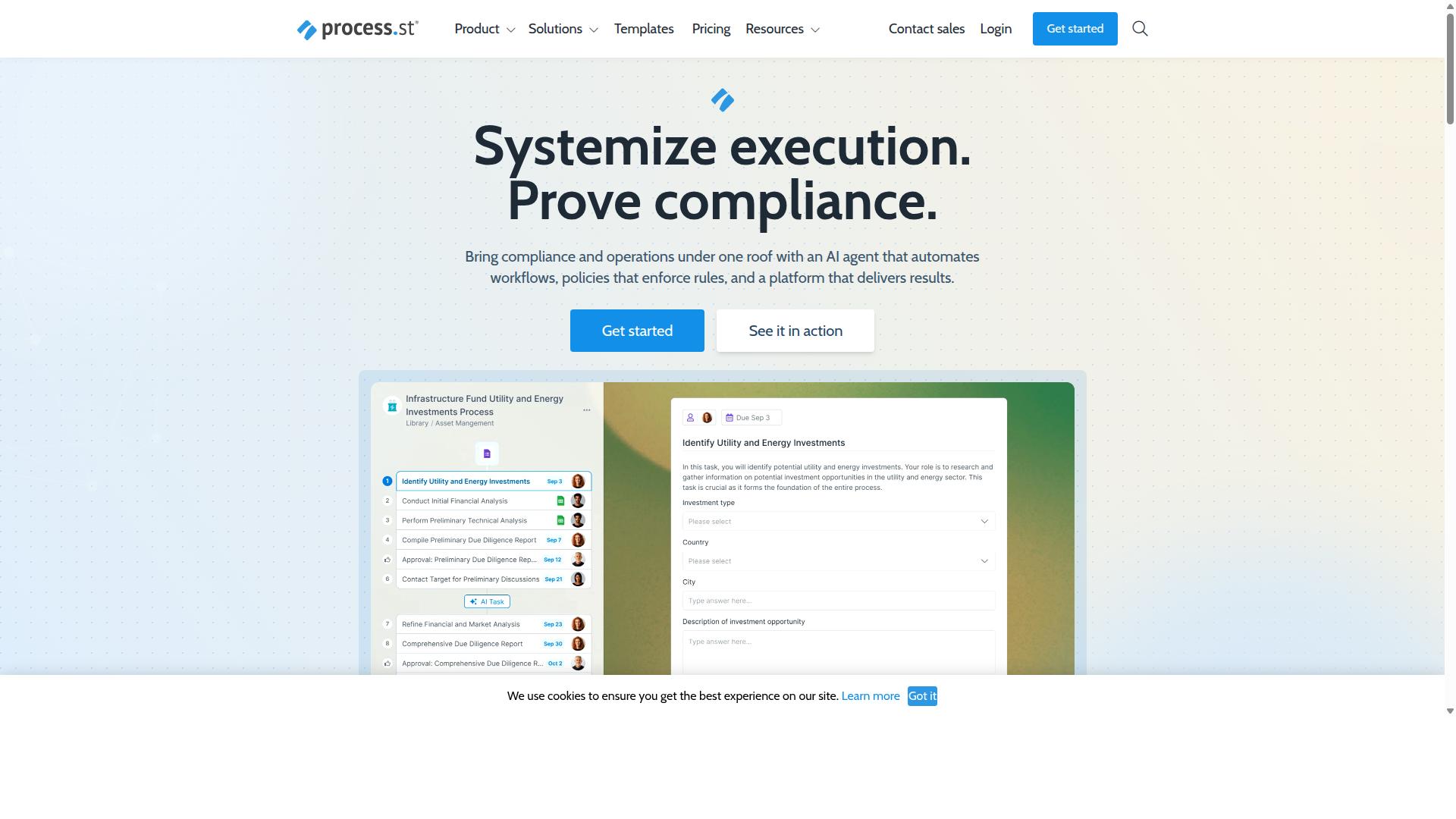
Process Street leads the comparison by combining policy control, workflow automation, and audit-ready proof in a single platform.
The platform serves 3,000+ companies with 1m+ users. Three products deliver the complete solution: Docs, Ops, and Cora AI agents.
Document governance, process orchestration, and risk monitoring work together. Organizations standardize processes while proving compliance across industries.
SOC 2 Type II, ISO 27001, HIPAA, GDPR, and CCPA certifications support regulated environments. Data never trains AI models.
Key Features for Quick Deployment
Three product features accelerate deployment: pre-built compliance templates, AI-assisted workflow generation, and a drag-and-drop editor.
Docs provides ISO 9001, SOC 2, SOX, and FDA document governance. Teams maintain audit trails and policy versions without additional tools.
Ops turns policies into AI-powered workflows. Process orchestration converts static documents into active automation sequences.
Cora monitors regulations and automates work 24/7. The AI agent flags compliance risks and assigns tasks automatically.
Zapier, Microsoft Power Automate, Tray.io, and Make integrations extend connectivity. Public API access supports custom requirements.
Setup Time and Ease of Use
IMCD UK reported a 75% reduction in setup time and 30% faster documentation with Process Street.
49k+ employees use the system for standardized onboarding. Process AI and analytics features help teams identify bottlenecks quickly.
Five-minute average response time and 98 percent customer rating indicate reliable support. Teams maintain momentum during implementation phases.
Pricing and Plans
Process Street offers three paid tiers designed to scale with company stage and automation volume.
The Startup plan supports up to 5 users and 10 guests. Teams receive 100 automation actions per month and 10 automation apps.
Pro and Enterprise plans provide unlimited workflows, tasks, users, and guests. Custom API calls, automation actions, and Data Set records accommodate larger operations.
Enterprise customers access dedicated success managers, priority support, and fully-managed workflows. Bulk document import and process consulting services support complex deployments.
AWS Marketplace availability simplifies procurement for organizations already using Amazon infrastructure. Fourteen-day free trials on Pro plans require no credit card.
2. Scrut Automation
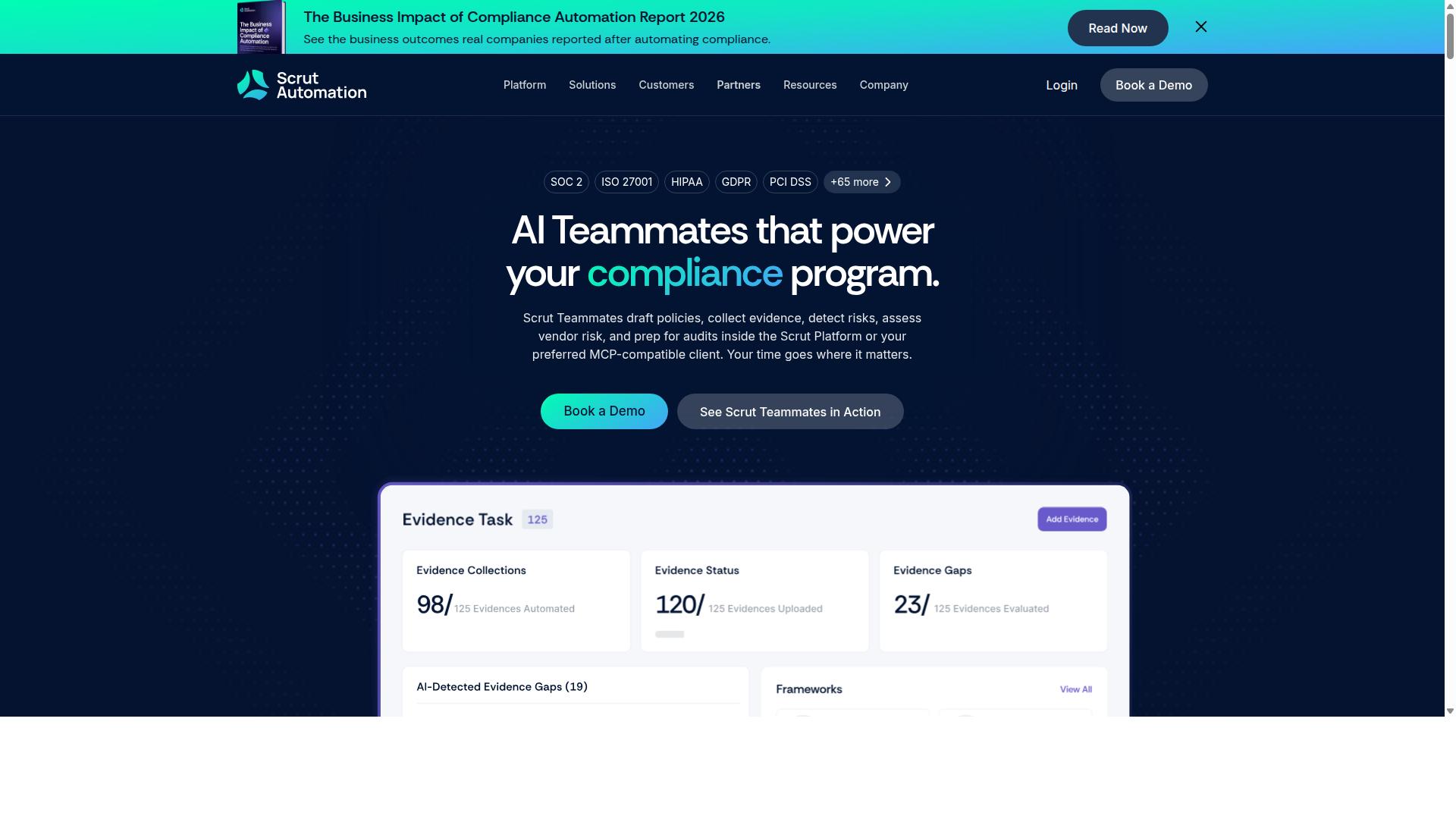
Scrut Automation focuses on continuous compliance monitoring and automated evidence collection for security frameworks.
Organizations often use this platform when they need centralized control over regulatory requirements across multiple frameworks. The system pulls data from connected sources to track control status without manual intervention.
Teams typically select this option when documentation and audit preparation form a large part of their daily workload. Integration with existing security tools helps reduce duplicate data entry across systems.
Key Features for Quick Deployment
Users report an intuitive evidence-collection workflow and pre-mapped control libraries.
Pre-built compliance templates allow teams to map existing security controls against common frameworks without starting from scratch. API connectors enable data flow between the platform and other business systems.
The interface supports drag-and-drop configuration for most setup tasks. Conditional logic helps route evidence to the correct control categories automatically.
Teams can create custom workflows that match their current compliance processes rather than forcing a complete overhaul of existing procedures.
Setup Time and Ease of Use
Setup typically ranges from hours to a couple of days depending on the number of evidence sources.
Configuration steps include connecting data sources, mapping controls to frameworks, and testing automated collection rules. The user interface guides users through each step with clear instructions.
Teams with existing compliance documentation often complete initial setup faster than those building control libraries from the ground up. Training requirements remain minimal due to the familiar workflow patterns.
Support resources include documentation and video guides that walk through common setup scenarios. Most users can handle basic configuration without additional assistance.
Pricing and Plans
Pricing is quote-based and varies by control volume and user count.
Potential customers contact the vendor directly to receive custom pricing based on their specific compliance needs. Factors that influence cost include the number of frameworks tracked and the complexity of evidence sources.
Enterprise teams often request detailed quotes that outline features available at different service levels. The absence of public pricing makes initial budget planning more challenging for smaller organizations.
Teams evaluating this option typically schedule vendor calls early in their research process to understand total cost of ownership before committing to implementation.
3. Vanta
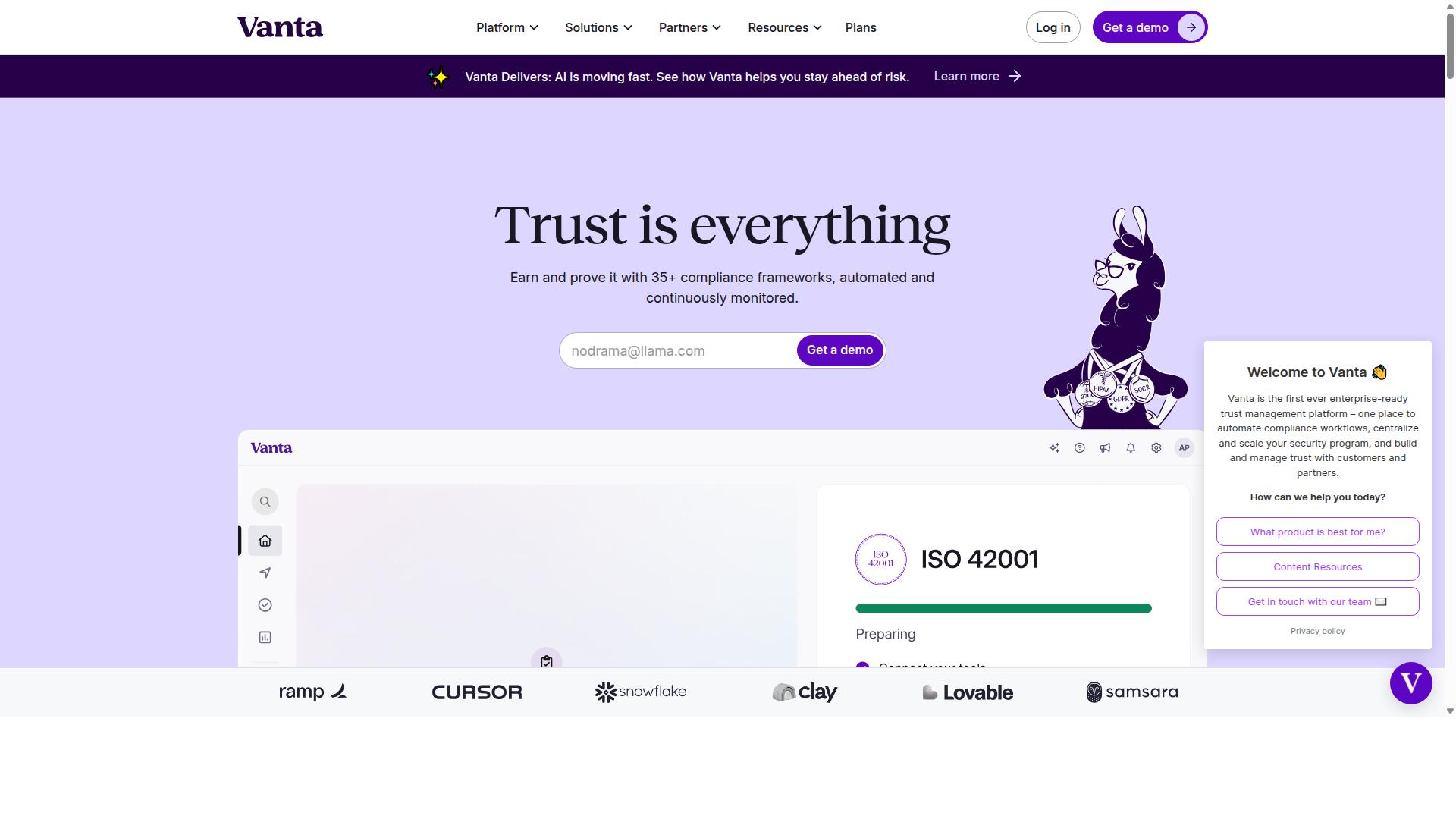
Vanta provides automated security and compliance monitoring through hundreds of integrations.
The platform focuses on continuous monitoring rather than one-time assessments. Organizations use it to track security controls across cloud environments and third-party services.
Teams gain visibility into compliance status without manual evidence collection. The system pulls data from existing tools and presents findings in a centralized dashboard.
Key Features for Quick Deployment
The platform supplies pre-built tests and continuous monitoring across cloud services.
Available connectors cover major cloud providers and business applications. New accounts can activate these connections without writing custom code.
Pre-built compliance tests address common frameworks like SOC 2 and ISO 27001. Users select relevant tests and map them to their existing infrastructure.
Configuration happens through a web interface that guides teams through connection steps. The process requires standard credentials rather than specialized technical knowledge.
Setup Time and Ease of Use
Most organizations complete initial setup within one to three days.
Account creation involves selecting the compliance frameworks to monitor. Users then connect relevant cloud accounts and business applications.
The interface presents setup steps in sequence. Teams can work through connections individually without affecting the rest of the configuration.
Support documentation covers common connection scenarios. Organizations with standard cloud setups often find the default options sufficient for their needs.
Pricing and Plans
Plans are subscription-based and scale with monitored assets.
Organizations contact the vendor directly to discuss specific requirements. Pricing depends on the number of connected services and compliance frameworks needed.
The vendor offers different service levels based on company size and complexity. Enterprise teams may require additional features around reporting and access controls.
Potential users should request a consultation to understand exact costs. The pricing model reflects the scope of monitoring rather than user count.
How to Choose the Right Option
Selection hinges on aligning platform capabilities with team size, compliance scope, and integration requirements.
Financial services teams face strict oversight requirements. Two decision criteria matter most, regulatory alignment and audit trail completeness. Platforms must support SOX automation while integrating with existing accounting systems.
Healthcare organizations need HIPAA workflows that protect patient data at every step. The critical criteria include encryption standards and access controls that meet federal guidelines.
Technology startups scaling onboarding require platforms that grow with rapid hiring cycles. Their priorities center on deployment speed and template flexibility that adapts to changing team structures.
Each industry presents unique constraints that influence which workflow automation solution fits best. Teams in operations, customer management, compliance, human resources, finance, and IT security benefit from matching their specific needs to platform strengths.
Process Street serves organizations across financial services, healthcare, and technology sectors with use cases including employee onboarding, client onboarding, ISO compliance, quality tracking, and document control. The platform supports custom workflows tailored to each industry's compliance demands.
Final Verdict
Process Street stands out for teams that need both rapid workflow deployment and embedded compliance controls. The platform serves over 3,000 companies and more than one million users worldwide. These organizations consistently report faster documentation cycles and reduced setup times across multiple departments and regions.
Security certifications underpin the platform's appeal. Process Street maintains SOC 2 Type II certification and holds ISO 27001 certification. Additional compliance frameworks include HIPAA, GDPR, CCPA, and AWS CIS standards. A business associate agreement is available upon request for healthcare organizations.
Time savings appear across multiple use cases. One customer, IMCD UK, recorded a 75% reduction in setup time after implementation. Another organization standardized onboarding for 49,000 employees. The average five minute support response time and 98% customer rating further support rapid deployment requirements.
Process Street follows the principle that data is never used to train AI models. This policy addresses privacy concerns that surface when teams evaluate workflow automation platforms. Organizations requiring strict data handling standards find this approach aligns with their internal policies.
The platform appears on AWS Marketplace, providing procurement simplicity for teams already operating within that ecosystem. This availability reduces the typical friction associated with vendor evaluation and contract approval processes.